What “Phasing Out” Really Means
The headline said six synthetic dyes were getting banned. The fine print said something much softer — and they’re still in your cart today.
By the Svelio editorial team · June 9, 2026
01
Red 40
02
Yel 5
03
Yel 6
04
Blue 1
05
Blue 2
06
Grn 3
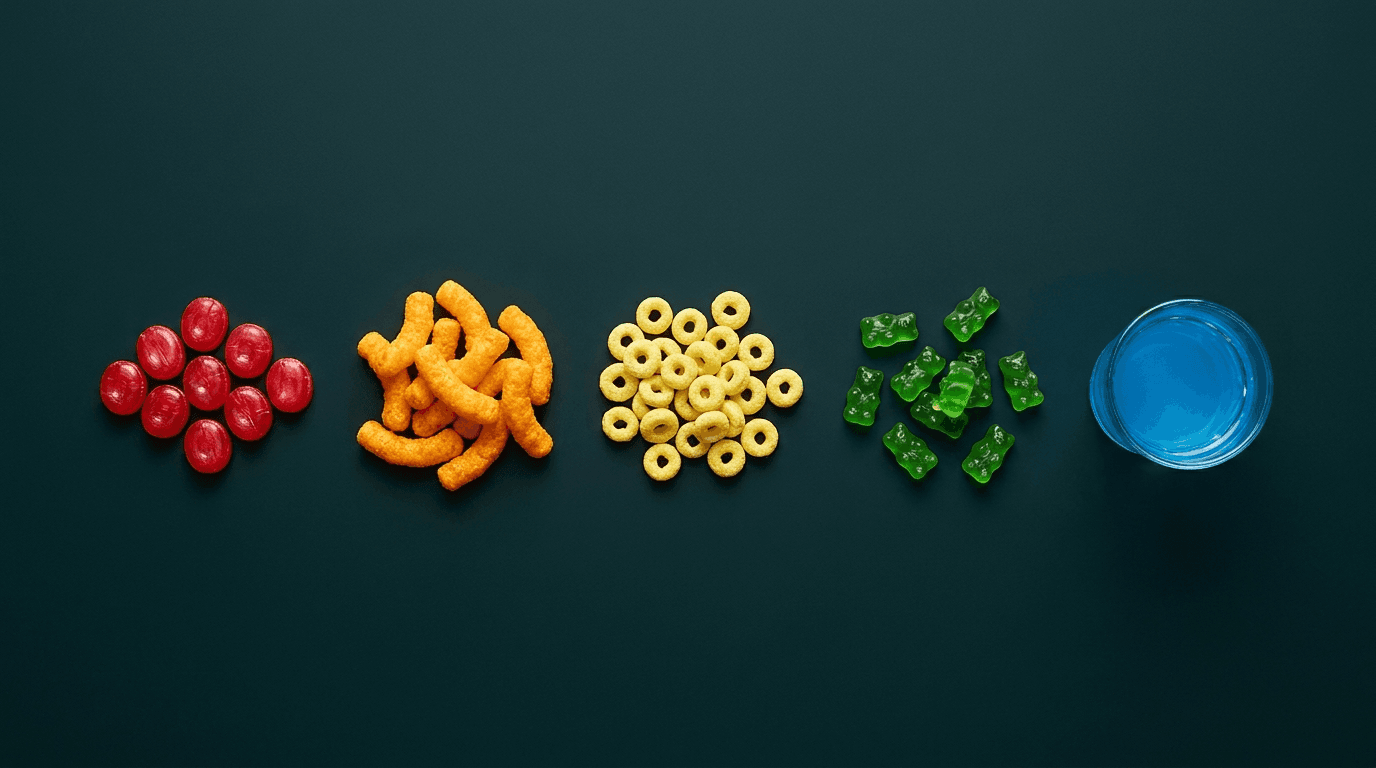
In April 2025, the federal government announced that the bright synthetic colors in American food were on their way out. The headlines wrote themselves: six dyes banned. Cereal aisles would go beige. Skittles would taste the rainbow without wearing it.
More than a year on, the dyes are still here. Read a box of fruit cereal or a bottle of red sports drink today and the same FD&C numbers are usually right where they have always been. That gap — between what the announcement sounded like and what it actually did — is worth understanding, because it is mostly hidden in a single word.
The word is “voluntary”
On April 22, 2025, the Department of Health and Human Services and the FDA announced a plan to phase out the remaining petroleum-based synthetic dyes from the food supply, targeting the end of 2026. What they did not do was issue a rule. There is no regulation, no ban, and no enforcement date with teeth behind it. The mechanism is an understanding with the food industry to reformulate voluntarily, backed by FDA pressure and a public pledge tracker — not law.
That distinction matters. “Phase out” is not a synonym for “banned.” Several large manufacturers — among them Mars, Kraft Heinz, General Mills, and Kellogg's — have pledged to pull synthetic colors from at least some of their U.S. products. Pledges are a real signal, and some reformulations have already shipped. But a pledge is a plan, not a deadline you can hold anyone to, and the timeline has already softened from “end of 2026” toward 2027 in the industry's own commitments. Until a given product is reformulated, the dye is still in it.
The six on the list
These are the six certified synthetic colors named in the phase-out. A seventh, Red 3, is a separate and stronger story — the FDA actually revoked its authorization by final rule in January 2025, which is a ban; we covered it in Issue 01. The six below are the ones still riding on a handshake.
Red 40 (Allura Red, E129)
The most heavily consumed food dye in the United States, by a wide margin. If a product is red, pink, purple, or brown, this is usually how. It is also the dye California's health agency flagged as the single most consumed by children.
Where you'll find it: Skittles and most fruit-candy lines, Doritos and other nacho-cheese snacks, fruit-punch and red/orange Gatorade and Powerade flavors, Kellogg's Froot Loops and other brightly colored cereals, strawberry and cherry yogurts, and a long tail of drink mixes and seasonal candy. Many of these are mid-reformulation as of 2026 — the only reliable test is the current box in your hand.
Yellow 5 (Tartrazine, E102)
A lemon-yellow dye and one of the most-studied of the group. Frequently paired with Blue 1 to produce green. It can also trigger reactions in people sensitive to aspirin.
Where you'll find it: Boxed macaroni-and-cheese powder, lemon-lime and citrus sodas and sports drinks, some pickles and prepared mustards, snack chips, and yellow and green candies.
Yellow 6 (Sunset Yellow, E110)
An orange-yellow dye. In Europe, foods containing it carry a warning label about possible effects on children's attention and behavior.
Where you'll find it: Cheese-flavored snacks and crackers, orange sodas, certain breakfast cereals, packaged baked goods, and candy-corn-style confections.
Blue 1 (Brilliant Blue, E133)
A synthetic blue, generally considered one of the better-tolerated colors of the six, though it is not especially well studied for long-term effects. Combine it with Yellow 5 and you get most packaged greens.
Where you'll find it: Blue sports drinks and freezer pops, blue and green candies, and certain frostings and ice creams.
Blue 2 (Indigotine, E132)
Less common than Blue 1, and less studied. It shows up where a deeper, more violet blue is wanted.
Where you'll find it: Some candies and bottled blue beverages, a number of pet foods, and certain packaged baked goods.
Green 3 (Fast Green FCF, E143)
The least-used of the six by a large margin — so rare that many shoppers will never knowingly eat it. Included in the phase-out all the same.
Where you'll find it: Occasional mint and green candies, some canned and processed green produce, and a handful of beverages and ice creams.
What the science actually says
It is easy to over-read this story in either direction. The careful version comes from California's Office of Environmental Health Hazard Assessment, which in 2021 published the most thorough government review of the question to date. Its finding was measured: synthetic food dyes can cause or worsen hyperactivity and other neurobehavioral problems in somechildren, sensitivity varies from child to child, and the federal intake limits — set by the FDA decades ago — may not be low enough to protect children's behavior. Not “poison in every box.” Not “nothing to see here.” A real effect, in a subset of kids, that the existing limits were never designed to catch.
What replaces them — and the new claim to watch
The color does not have to come from petroleum. Over 2025 and into 2026 the FDA approved a run of color additives from natural sources — among them galdieria extract blue, butterfly pea flower extract, gardenia blue, calcium phosphate, and, in February 2026, beetroot red, alongside an expanded use of spirulina extract. These are what most reformulated products will reach for.
The same month, the FDA also said products colored only with these sources may advertise “No Artificial Colors” on the front of the pack. That is a genuinely useful signal — and also exactly the kind of front-of-pack phrase worth checking against the actual ingredient list, the moment marketing departments are handed a new sanctioned claim.
How to read for these
You don't need a press release to know whether a dye is in your food. The FD&C number is printed on the side of the box right now: Red 40, Yellow 5, Yellow 6, Blue 1, Blue 2, Green 3 — plus Red 3, the one that is genuinely on its way out by rule. Seven names. Once you can spot them, the “phase out” debate gets a lot simpler: you can just look.
Svelio flags all six of these dyes — and Red 3 — on every scan, with one short line about what each is and why it's flagged. The label already tells the truth. We just make it easier to read while the rest of the food supply catches up.
References
- California Office of Environmental Health Hazard Assessment. (2021). Health effects assessment: Potential neurobehavioral effects of synthetic food dyes in children.
- Center for Science in the Public Interest. (n.d.). Chemical Cuisine: Food additive safety ratings.
- CNN. (2026, February 5). FDA approves natural food dye beetroot red.
- Environmental Working Group. (n.d.). EWG's Food Scores.
- Food Safety Magazine. (2025). FDA announces plan to phase out synthetic, petroleum-based food dyes from U.S. food supply.
- Food Safety Magazine. (2026). FDA allows foods with “natural” food dyes to claim “No Artificial Colors”.
- National Agricultural Law Center. (2025). FDA announces plan to “phase out” synthetic dyes.
- Open Food Facts. (n.d.). Open Food Facts: The free food products database.
- U.S. Food and Drug Administration. (n.d.). Color additives: Information for consumers.
- U.S. Food and Drug Administration. (n.d.). List of select chemicals in the food supply under FDA review.
- U.S. Food and Drug Administration. (n.d.). Tracking food industry pledges to remove petroleum-based food dyes.
Editor's note: Brand and product mentions were cross-referenced across the Center for Science in the Public Interest's Chemical Cuisine, EWG's Food Scores, and Open Food Facts (cited above) before being named. Formulations are changing unusually fast in 2026 as the voluntary phase-out proceeds, so the package in your hand always trumps the post. Spotted a recent reformulation we missed? Email info@svelio.io.
““Phase out” is not a synonym for “banned.” One is a press release. The other is a rule.”
There's always something they're not telling you.
Each Brief is one investigation we couldn't sit on: an additive, a brand watch, a regulatory shift. The next one might be about your favorite snack.