Banned in the EU, sold in the U.S.
A short tour of the additives American shoppers eat every week that aren't legal in groceries overseas.
By the Svelio editorial team · May 17, 2026
01 · United States
US
02 · European Union
EU
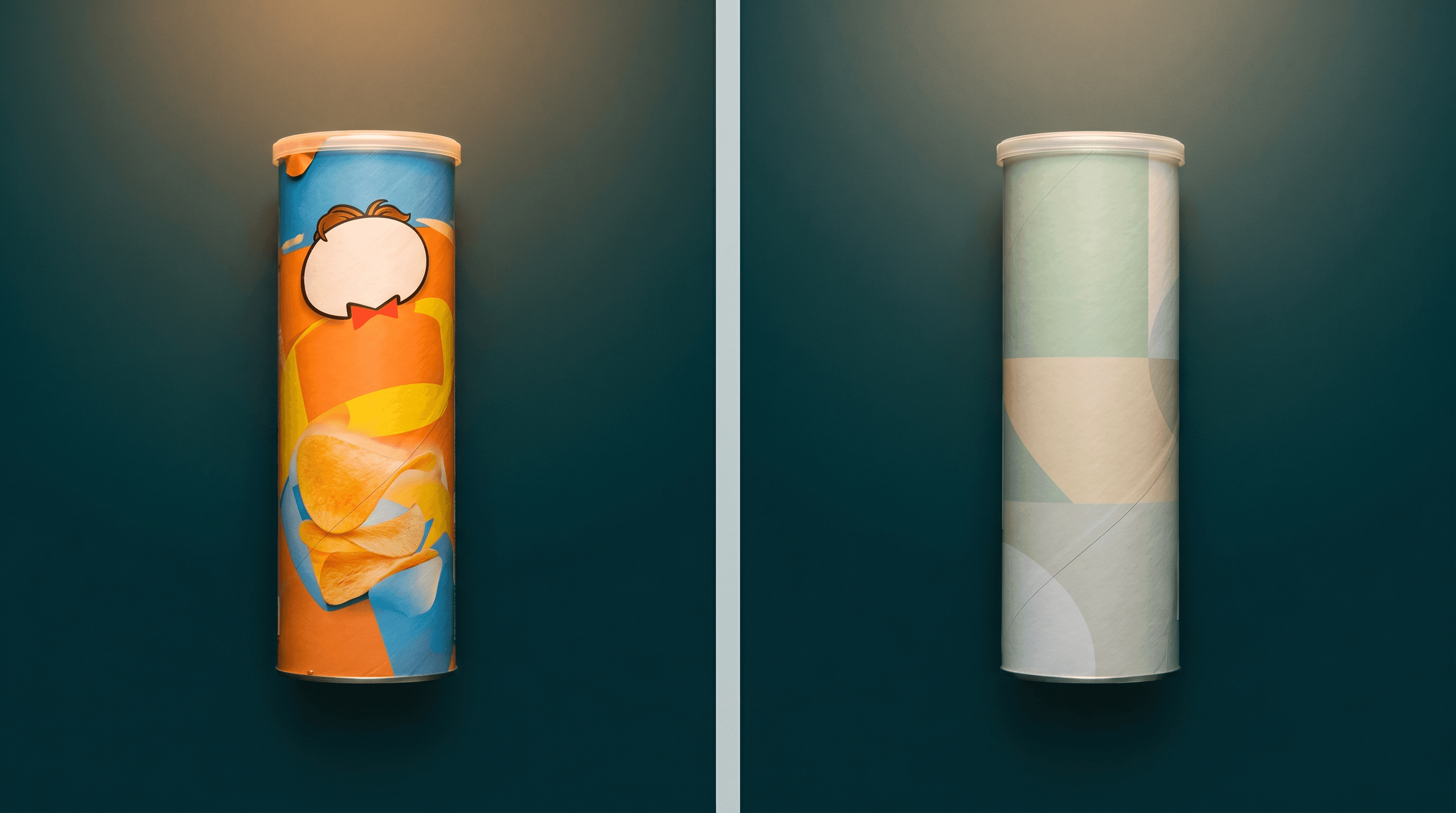
Walk down the cereal aisle in a Berlin grocery and the breakfasts look almost identical to the ones in a Cleveland Kroger — same boxes, same cartoon mascots, same morning promise. Flip the boxes over, though, and the ingredient lists diverge. Some additives that are common on the American side of the Atlantic aren't legal on the European side, and have not been for years.
The asymmetry isn't about chemistry. American and European food scientists agree on the underlying compounds. The disagreement is about burden of proof. The FDA's framework Generally Recognized as Safe— GRAS — clears an additive when industry experts conclude it's unlikely to cause harm. The European framework defaults toward the precautionary principle: if a panel concludes safety can no longer be established, the ingredient comes out. Different frameworks, different supermarket shelves.
Here are five that appear regularly on American labels and not on European ones. Read the back of the box.
Red 3 (Erythrosine, E127)
In Europe you don't find Red 3 in candy. In the United States you find it in maraschino cherries, strawberry milk, certain frostings, and a long list of seasonal candies — the same color the EU removed from general food use in 1994. The FDA banned Red 3 in cosmetics in 1990 but kept it in food for another thirty-five years. In January 2025, the agency finally moved to revoke the food authorization, with a January 2027 phaseout date. Until then, reach into a bag of bargain Easter candy: chances are it's still in there.
Where you'll find it: maraschino cherries (most brands), Pez (pink flavors), Brach's conversation hearts, certain Brach's candy corn varieties, Pediasure Strawberry, Hostess Strawberry Mini Donuts, and a meaningful chunk of the strawberry-flavored frosting and yogurt aisle.
Titanium Dioxide (E171)
A whitener — gives certain coffee creamers their opacity, some chewing gum its bright veneer, candies their crystalline glow. The EU banned it as a food additive in August 2022 after the European Food Safety Authority concluded it could no longer be considered safe in light of genotoxicity findings. In the U.S., it remains GRAS. Across the same brand, the European reformulation leaves it out; the American formulation does not.
Where you'll find it: Skittles, Trident gum, Mentos, Coffee-mate French Vanilla creamer, Wilton and Betty Crocker white frostings, certain candy-coated chocolates.
Potassium Bromate
A flour "improver" — speeds gluten development, gives commercial breads their soft, uniform crumb. Banned in the EU, Canada, the U.K., Brazil, China, and Peru. California requires a Proposition 65 warning label on any product containing it. The FDA permits it nationwide. The next supermarket loaf of white sandwich bread you pick up, read the back: if the ingredient list ends with "enriched flour [contains potassium bromate]," that's it.
Where you'll find it: cheap commercial white sandwich loaves generally, some Goya rolls and breadsticks, certain regional pizza chains' crusts, and a long tail of bakery-aisle store brands. Tell-tale label phrasing: enriched flour [contains potassium bromate].
BHA / BHT
Butylated hydroxyanisole and butylated hydroxytoluene — preservatives that keep oils from going rancid in cereals, snack bars, chips, gum. The European Union restricts BHA to specific applications and prohibits it in baby food. BHT is permitted only at low limits. In the U.S., both are GRAS and routinely appear in breakfast cereals marketed to children. Again: same chemistry, different framework.
Where you'll find it: General Mills cereals (Lucky Charms, Cocoa Puffs), Kellogg's varieties, Quaker Instant Oatmeal flavored packets, Wrigley's chewing gum, much of the snack-bar and protein-bar aisle, and cereal packaging itself (BHT in the liner to preserve the oils inside the product).
Azodicarbonamide (ADA)
A dough conditioner sometimes called the "yoga mat chemical" because it's the same compound used to foam yoga mats and shoe soles. Banned in the EU, Australia, Singapore, and the U.K. In the U.S. it's permitted at up to 45 parts per million in flour. Subway pulled it from their bread in 2014 after public pressure; other large chains still use it. The word azodicarbonamide on a bread ingredient list is the one to look for.
Where you'll find it: Wonder Bread (some varieties), Pillsbury Buttermilk Biscuits, Sara Lee Soft & Smooth historically, Pepperidge Farm white sandwich loaves, and the buns at many fast-food chains. The two usually-named exceptions are Subway (removed 2014) and Chipotle (never used it).
How to read for these
None of this is fearmongering. The American food supply is largely safe, and European food isn't a guarantee of purity either — different regulators draw different lines for different reasons. The point is the asymmetry, and the fact that you can usually read it on the side of the box if you know what to look for.
Svelio flags each of these additives on every scan, with one short line about why it matters and where it's banned. The label already tells the truth. We just make it easier to read.
References
- California Office of Environmental Health Hazard Assessment. (n.d.). Proposition 65 list.
- Center for Science in the Public Interest. (n.d.). Chemical Cuisine: Food additive safety ratings.
- Council of the European Communities. (1994). Council Directive 94/36/EC on colours for use in foodstuffs. European Union.
- Environmental Working Group. (n.d.). EWG's Food Scores.
- European Commission. (2022). Commission Regulation (EU) 2022/63 as regards titanium dioxide (E 171). European Union.
- European Food Safety Authority. (2021). Safety assessment of titanium dioxide (E171) as a food additive. EFSA Journal, 19(5), Article 6585.
- European Parliament & Council of the European Union. (2008). Regulation (EC) No 1333/2008 on food additives. European Union.
- International Agency for Research on Cancer. (n.d.). IARC Monographs: List of classifications. World Health Organization.
- Open Food Facts. (n.d.). Open Food Facts: The free food products database.
- U.S. Food and Drug Administration. (2025). FD&C Red No. 3.
- U.S. Food and Drug Administration. (2025, January 16). Color additive petition; request to revoke listing for FD&C Red No. 3 in food and ingested drugs [Final rule]. Federal Register, 90, 4628.
- U.S. National Toxicology Program. (n.d.). Report on Carcinogens.
- World Health Organization, International Programme on Chemical Safety. (1999). Azodicarbonamide (Concise International Chemical Assessment Document No. 16).
Editor's note: Brand and product mentions were cross-referenced across the Center for Science in the Public Interest's Chemical Cuisine, EWG's Food Scores, and Open Food Facts (cited above) before being named — and, where a regulatory action named a brand directly, that document is treated as primary. Formulations change; the ingredient list on the package in your hand is always the most reliable test. Spotted an error or a recent reformulation we missed? Email info@svelio.io.
“The same product, the same brand, two continents, two ingredient lists.”
There's always something they're not telling you.
Each Brief is one investigation we couldn't sit on: an additive, a brand watch, a regulatory shift. The next one might be about your favorite snack.