The front of the box is an ad.
Six claims that are legal to print, and the lines on the back that decide whether they are true.
By the Svelio editorial team · July 27, 2026
01 · The advertisement
Front
02 · The disclosure
Back
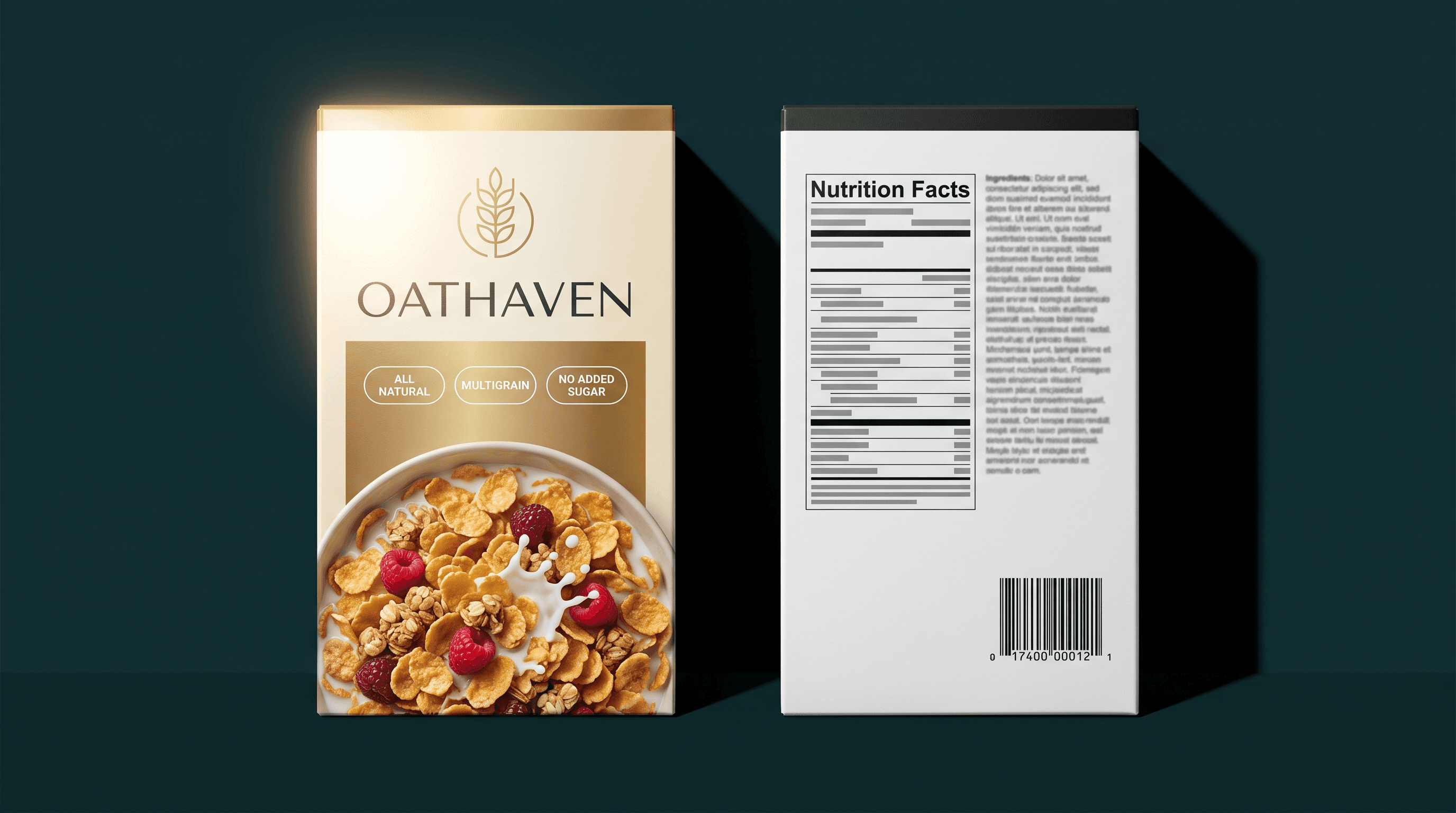
A box of cereal is two documents in one. The back is a legal disclosure, governed to the gram, with rounding rules and a federal reference table standing behind every number on it. The front is an advertisement. It is designed, art directed, and market tested, and a surprising amount of what it says is either loosely defined or not defined at all.
That asymmetry is the most useful thing to understand about a grocery store. The words that sell the product and the numbers that describe it are written by different people under different rules, and then printed inches apart on the same package. Here are six claims you will walk past this week: what each one actually requires, and the line on the back that settles it.
1. “All Natural”
Start with the biggest one, because it is the emptiest. The FDA has, in its own words, “not engaged in rulemaking to establish a formal definition for the term ‘natural’”. What exists instead is a longstanding policy: the agency has considered “natural” to mean that nothing artificial or synthetic, including all color additives regardless of source, has been added to a food that would not normally be expected to contain it.
Read the rest of that policy and the ground gets softer. It was never intended to address production methods such as pesticide use. It does not explicitly address processing or manufacturing methods. And the agency states plainly that it did not consider whether the word should describe any nutritional or health benefit at all. The FDA asked the public to help it define the term and closed the comment period on May 10, 2016. A decade later there is still no rule.
What settles it: the ingredient list. A synthetic color, an artificial sweetener, or a chemical preservative puts the product outside the agency's own working definition, whatever the front says.
Where you'll find it: Snack and granola bars, juice drinks, deli meats, frozen entrees, and flavored yogurts (some varieties). The claim is legal on all of them.
2. “Healthy”
“Healthy” is the opposite case. It has been a regulated term for decades, but the old criteria were built around limiting total fat, an idea nutrition science moved past. So a fat-free pudding could qualify and a handful of almonds could not.
On December 19, 2024 the FDA finalized a rule rewriting it. Under the updated claim a product has to contain a meaningful amount of food from at least one food group the Dietary Guidelines recommend, and stay under specific limits for added sugars, saturated fat, and sodium. That is a real standard, and it is a considerable improvement.
The date is the catch. The rule took effect on April 28, 2025, but the compliance date is February 25, 2028. Until then a package can carry “healthy” on the old criteria. The word on the shelf today is not yet the word the rule describes.
What settles it: sodium and added sugars, read as percentages. Twenty percent or more of the Daily Value in a single serving is a lot of a day's allowance spent in one sitting.
3. “No Added Sugar”
This one is honest about something other than what most shoppers think. Under 21 CFR 101.60, “no added sugar” may be used only if no sugars, or ingredients containing sugars that functionally substitute for added sugars, were added during processing or packaging.
Notice what that governs. It is a claim about the manufacturing process, not a claim about how much sugar is in the food. A fruit juice concentrate can be extraordinarily sugary and carry the line legitimately. A separate rule covers “sugar free,” which does have a number behind it: less than half a gram of sugars per serving. Two claims, two rules, one shelf.
What settles it: the Total Sugars line, plus the ingredient list read for the aliases. Corn syrup, high-fructose corn syrup, dextrose, cane juice, and maltose are all sugar wearing a different name.
Where you'll find it: Juice and juice blends, dried and canned fruit, cereals, trail mixes, and yogurt (some varieties).
4. “Low Fat” and “Reduced Fat”
These two look like siblings and behave nothing alike. “Low fat” is an absolute: three grams of fat or less per reference serving. It means what you think it means.
“Reduced fat” is a comparison. It requires at least 25 percent less fat than an appropriate reference food, which is usually the regular version of the same product. Twenty-five percent less than something very fatty is still fatty. The claim is true and the product is not light.
There is a second-order effect worth knowing. Fat carries flavor and texture, so pulling it out often means putting something back in, and that something is frequently sugar or starch.
What settles it: Total Fat as a percentage of the Daily Value, and then the Added Sugars line directly below it. Read them together or you will only see half the trade.
5. “Multigrain” and “Made with Whole Grain”
Multigrain means more than one grain. That is the entire claim. It says nothing about whether any of those grains are whole, and refined flour from three grains still qualifies. The visual language does the rest: brown packaging, a wheat sheaf, visible seeds on the crust.
“Made with whole grain” is thinner still, because it carries no minimum. A loaf made mostly with refined flour and a little whole wheat can say it. The FDA's guidance on whole grain label statements recommends that products labeled “100 percent whole grain” contain no non-whole grain ingredients, which is a meaningful line. It has been in draft since 2006.
What settles it: the first ingredient, because ingredients are listed by weight, and the fiber line. If the word “whole” does not open the list and the fiber is low, the grain story is decoration.
Where you'll find it: Sandwich breads, crackers, breakfast cereals, tortillas, and snack chips (some varieties).
6. “High Protein”
Protein is the claim of the moment, printed on things that were candy two years ago. It is also one of the few front-of-pack words with a clean number behind it, which makes it easy to check.
Under 21 CFR 101.54, “high,” “rich in,” and “excellent source of” all require 20 percent or more of the Daily Value per reference serving. “Good source,” “contains,” and “provides” require 10 to 19 percent. The Daily Value for protein is 50 grams. Do the arithmetic and the bar for “high protein” is 10 grams a serving. “Good source” runs from 5 to just under 10.
Then there is the loophole underneath all of it. Calling something a “Protein Bar” is naming the product, not making a nutrient content claim, so the numeric thresholds never attach. The word can sit in 48-point type without promising anything.
What settles it: the grams, against 10. And the sugar line beside them, because a bar clearing the protein bar honestly can still be a confection.
And one the back rounds away
Every claim above lives on the front. This last one is on the panel itself, which is why it is the most quietly misleading number in the aisle.
The nutrition labeling rule at 21 CFR 101.9 specifies that for trans fat, “if the serving contains less than 0.5 gram, the content, when declared, shall be expressed as zero.” So “0g Trans Fat” is the outcome of a rounding rule, not a statement of absence. Eat three servings of something carrying 0.4 grams apiece and the label has told you zero three times.
What settles it: the ingredient list, searched for the words “partially hydrogenated.” That phrase is the source, and it survives the rounding.
The regulators agree, and they are running late
The argument of this piece is not a fringe position. In January 2025 the FDA proposed requiring a front-of-package “Nutrition Info box” on most packaged foods: a small panel on the front that rates saturated fat, sodium, and added sugars as Low, Med, or High. The comment period closed in July 2025 under docket FDA-2024-N-2910.
Strip out the procedure and that is a regulator concluding the front of the box should have to answer to the back. It is the right idea. It also covers three nutrients, applies to packaged foods only, and is years from a shelf near you. Everything else stays where it has always been, in small type, on the back, in a language the front is not obliged to speak.
Which is the job we built Svelio to do. Point it at the panel and every nutrient gets classified against the FDA Daily Values as low, moderate, or high with the arithmetic shown rather than a score you have to trust. More than forty additives get flagged by risk level, partially hydrogenated oil among them, no matter what the trans fat line rounds to. And the claims on the front get checked against the ingredients on the back, which is the comparison this whole issue is about, run automatically on every label you scan.
References
- Code of Federal Regulations. (2026). 21 CFR § 101.9: Nutrition labeling of food. Office of the Federal Register.
- Code of Federal Regulations. (2026). 21 CFR § 101.54: Nutrient content claims for “good source,” “high,” “more,” and “high potency”. Office of the Federal Register.
- Code of Federal Regulations. (2026). 21 CFR § 101.60: Nutrient content claims for the calorie content of foods. Office of the Federal Register.
- Code of Federal Regulations. (2026). 21 CFR § 101.62: Nutrient content claims for fat, fatty acid, and cholesterol content of foods. Office of the Federal Register.
- U.S. Food and Drug Administration. (2006). Draft guidance for industry and FDA staff: Whole grain label statements.
- U.S. Food and Drug Administration. (2024). Food labeling: Nutrient content claims; definition of term “healthy”. Federal Register, 89(248).
- U.S. Food and Drug Administration. (2025). Front-of-package nutrition labeling.
- U.S. Food and Drug Administration. (2025). Use of the “healthy” claim on food labeling.
- U.S. Food and Drug Administration. (n.d.). Use of the term “natural” on food labeling.
Editor's note: This issue describes what claims legally require, not what any specific product contains. Product categories were kept general deliberately: every claim named here is lawful, and the point is the gap between the rule and the reader's assumption, not any one brand's conduct. The package photographed above is a fictional product created for this article. Any resemblance to a real brand is unintended. Regulatory dates are current as of publication and compliance deadlines move. Formulations change; the package in your hand always trumps the post. Spotted an error? Email info@svelio.io.
“The words that sell the product and the numbers that describe it are written under different rules, and printed inches apart.”
There's always something they're not telling you.
Each Brief is one investigation we couldn't sit on: an additive, a brand watch, a regulatory shift. The next one might be about your favorite snack.